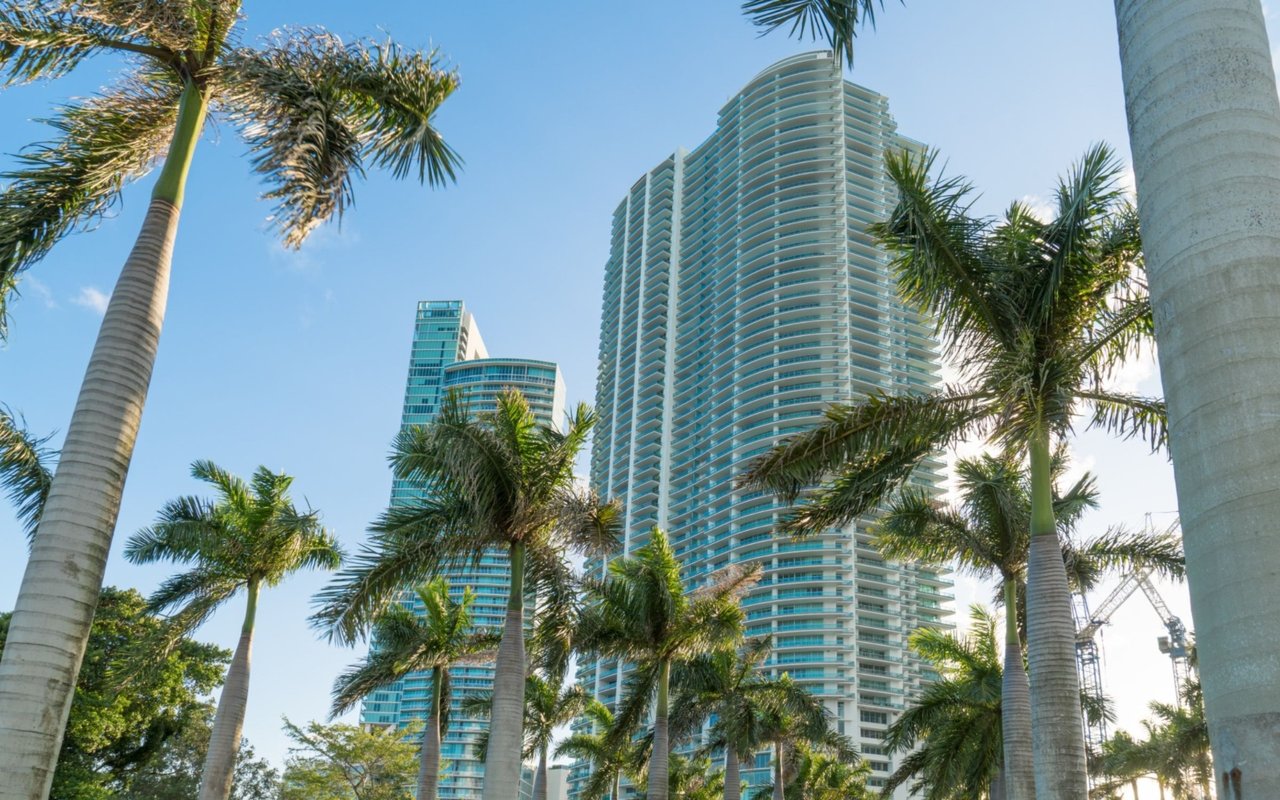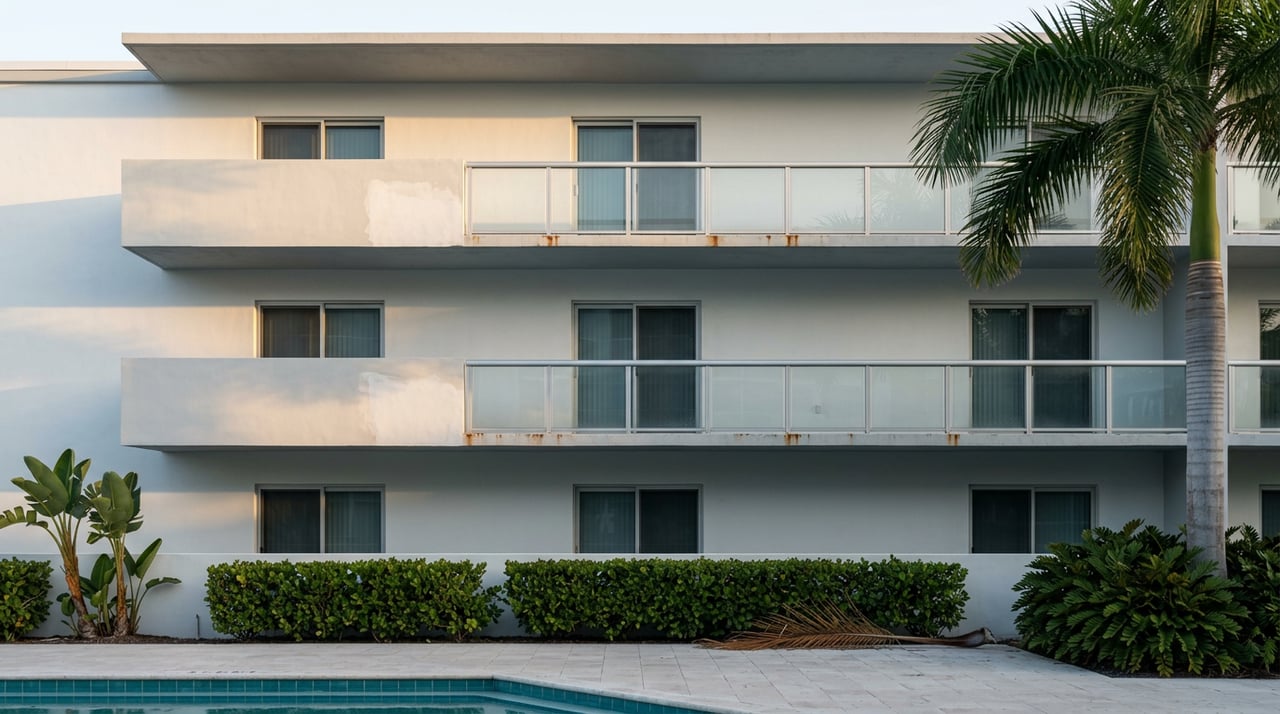
Two three-bedroom units. Same tower, same floor plan, same ocean view, listed six weeks apart this year. One went under contract close to asking. The other sat, took a price cut, and is still waiting. The finishes were nearly identical. The difference wasn't the kitchen or the balcony. It was the building's reserve account, and specifically, what the board's most recent structural report said about it.
That split is becoming the defining fact of condo resale on Key Biscayne right now, and it's a fact that a median sale price can't show you.
The law that rewrote what a condo comp means
Florida's post-Surfside reforms, starting with Senate Bill 4-D in 2022 and refined through SB 154 and House Bill 913, require every condominium three stories or taller to complete two things: a milestone structural inspection and a Structural Integrity Reserve Study, known as a SIRS. The milestone inspection answers whether the building is structurally sound today. The SIRS answers whether the association has actually saved enough to pay for what the building will need next.
For years, boards could vote to waive or underfund reserves for big-ticket items like roofs, elevators, and load-bearing structure. That option is gone. For budgets adopted on or after January 1, 2025, associations can no longer waive SIRS reserves for the components the law names: roof, load-bearing walls, fire protection, plumbing, electrical, waterproofing, and windows and exterior doors. Because most condo budgets are set at the end of the calendar year for the year ahead, the practical effect landed for owners starting in January 2026, when monthly dues on many older buildings jumped to reflect real reserve funding for the first time in decades.
Key Biscayne sits on a barrier island, which matters here in a way it wouldn't in an inland building. The statewide milestone trigger is 30 years from certificate of occupancy, but any building within three miles of the coast, including tidal water like Biscayne Bay, falls under a 25-year trigger instead. Effectively every condo tower on the island has already gone through, or is about to go through, its first cycle years earlier than a comparable building would inland.
A conversation at The Sands
The clearest local account of what this looks like in practice came from Sam Schrager, president of The Sands Condominium Association and president of the Key Biscayne Condominium Presidents Council, in a 2024 interview with the Islander News. The Sands, built in 1969, is the island's second-oldest condo building after Island House, and it had already completed its 40-year and 50-year recertifications by the time the new state rules arrived.
"It used to be roofs, elevators, pavement and painting. Now, it's pretty much everything. You have until the end of 2025 to have it all funded. It makes the year go very fast."
Schrager described a building doing concrete restoration on a maintenance cycle, not because anything had failed, but because salt air and time work on concrete the way weather works on anything else. Owners would ask why the work was happening again so soon after a prior round. His answer, as reported by the Islander News, was blunt: "concrete is maintenance," the same way a lawn needs mowing even though you mowed it last week. The Sands was also mid-retrofit on fire sprinklers across all 120 units at the time, a separate mandate layered on top of the structural requirements.
None of that makes The Sands an outlier. It makes it a representative case of what every 25-year-or-older tower on the island is now working through, at different points in the cycle, with different starting reserve balances. That's the variable a listing photo can't show you and a price-per-square-foot comp doesn't capture.
What a buyer should actually ask for
State Rep. Vicki Lopez explained the funding math to the Islander News this way: if a roof has a 10-year useful life and will cost $1 million to replace at the end of that life, the association must reserve $100,000 a year for 10 years so the money is there when the roof needs it. A building that started that clock on time looks financially unremarkable. A building that skipped years of funding under the old waiver rules is now compressing that same math into a shorter runway, and the gap usually surfaces as a special assessment.
Before writing an offer on a Key Biscayne condo, request:
- The most recent milestone inspection report, and note whether it's Phase 1 (visual) or Phase 2 (destructive testing triggered by findings)
- The current Structural Integrity Reserve Study and its funding schedule
- Board meeting minutes from the last 12 to 24 months, which usually surface a pending assessment well before it's formally approved
- The estoppel certificate, which will state any special assessment or unpaid balance tied to the specific unit
- The association's insurance summary, since reserve gaps and hard-market premiums tend to travel together
A cash purchase doesn't remove the need for this review. Without a lender doing independent underwriting, the buyer is the only party checking whether the numbers hold together.
The clock that starts once documents arrive
Florida law gives condo buyers real leverage here, but it's time-boxed. Under Florida Statute 718.503, a buyer has the right to cancel the contract within three days of actually receiving the required condominium disclosure documents, not three days from signing. If those documents arrive late in the process, that cancellation window can effectively extend the buyer's exit right closer to closing than either side expected.
On the seller's side, an association must deliver an estoppel certificate within 10 business days of a written request, according to closing procedures used by title companies handling Key Biscayne transactions, including Union Title Services, which processes association estoppels and disclosure packages for island closings. The certificate is valid for 30 days once issued, which is why timing the request matters on a longer marketing period. A stale estoppel means reordering it, and reordering it after a pending assessment gets approved can change the number on the page entirely.
Two buildings, two trajectories
| Building funding reserves on schedule | Building catching up post-2026 | |
|---|---|---|
| Monthly dues | Predictable, gradual increases | Sharp jump as SIRS-mandated reserves phase in |
| Special assessment risk | Low, funded ahead of need | Higher, often triggered by the milestone report itself |
| Marketability | Comps hold, financing straightforward | Price cuts common, lenders scrutinize the file |
| Negotiating position | Seller has leverage | Buyer has leverage, if they know to ask |
Why the island median won't tell you this
Key Biscayne's blended residential median sale price came in at $1.4 million in March 2026, down 24 percent from the same month a year earlier, with the average time on market stretching to 183 days from 105 days the prior year. In the 33149 zip code specifically, the median sale price stood at $1,782,500 as of June 2026 across 210 recorded sales, with 153 active listings on the market at that time.
Numbers like these get read as a cooling market. They're better read as a blending problem. Waterfront single-family homes and older condo units get folded into the same headline figure, even though a renovated house on a canal and a 1970s-era condo unit are responding to completely different pressures. Miami-Dade's broader luxury market was strong in the same window: single-family sales above $1 million rose more than 21 percent year over year in the first quarter of 2026, and the county's own luxury price threshold climbed to roughly $4.1 million, according to the MIAMI Association of Realtors. Houses are not the segment absorbing the reserve-law shock. Older condo buildings are, and that's exactly the segment an island-wide median tends to bury.
If you're comparing two units and one keeps citing its price against "the market," ask which market. A building with funded reserves and a clean milestone report is trading against Miami-Dade's strong luxury year. A building still catching up is trading against buyer hesitation that has nothing to do with the unit itself.
A few questions worth asking directly
Does a cash offer make document review optional? No. Cash removes a lender's independent underwriting, which means the buyer's own review of the SIRS, milestone report, and board minutes becomes the only check in place.
What's the real difference between a milestone inspection and a SIRS? The milestone inspection is an engineer's opinion on the building's physical condition today. The SIRS is the financial plan showing whether the association has saved enough to pay for what that inspection, or the building's age, says it will eventually need.
Can a buyer negotiate for the seller to cover a pending assessment? Often, yes, particularly when the assessment is disclosed in the estoppel certificate before the contract is finalized. It becomes a negotiating point rather than a surprise, which is the entire reason to request the documents early.
Does this apply to single-family homes on Key Biscayne? No. Milestone inspections and SIRS requirements apply to condominium and cooperative buildings three stories or higher. Single-family homes are not subject to these statutes.
A condo's price on Key Biscayne now depends as much on its association's paperwork as on its finishes. Reading that paperwork correctly, and reading it early, is the difference between negotiating from strength and finding out what's wrong after the deposit is down. If you're weighing a purchase or a sale on the island and want a second set of eyes on a building's actual financial position before you write an offer or set a list price, Urdapilleta Real Estate can walk through the specific documents with you. Schedule a private consultation to start.